


The landscape of higher education is changing fast. Students are asking tough questions about whether going to college is worth it. They’re looking at the high costs and wondering what they’ll really get in return. This skepticism is a challenge for colleges and universities, which now have to work harder to show the value of the education they offer.
And the hill is only getting steeper. In a 2023 Statista study, Gen Z adults were split about 50/50 about whether college is “a smart investment in the future” or “more of a gamble that may not pay off in the end.” And a New York Times podcast put it this way: “New research and polling show that more and more Americans now doubt a previously unquestioned fact of U.S. life — that going to college is worth it.”
This is where smart branding comes into play. Colleges and universities today need to tell a compelling story about what makes them different and why their education is worth the investment. A good branding strategy doesn’t just talk about academic programs; it connects with prospective students on an emotional level, showing the real-life impact of getting a degree.
In this guide, we’re going to break down how higher education institutions can use branding to effectively communicate their value. We’ll share 12 practical tips for standing out in a crowded market and proving to students that pursuing an education will pay off, not just in terms of a diploma, but in preparing them for a successful future.
Understanding Prospective Students in 2025
The pool of prospective students in 2025 is more diverse and complex than ever before. To effectively connect with them through branding, it’s crucial to understand who they are, what they’re looking for, and the challenges they’re facing. Here’s a closer look at the current landscape:
Demographic Shifts and Their Impact on Student Populations
Today’s students come from various backgrounds and life stages, making the one-size-fits-all approach to education and marketing outdated. Notably, higher education marketers are now facing a phenomenon known as the “demographic cliff” or the “enrollment cliff.” Caused by a combination of declining birth rates and other demographic shifts, the enrollment cliff predicts a decline in the traditional college-age population of about 15% between 2025 and 2029. This shift is likely to pose significant enrollment challenges for some higher education institutions, most notably residential undergraduate schools in regions hardest-hit by population loss.
Another significant trend is the shift toward more non-traditional students. As of 2022, more than 47% of people entering college were over 25 years old, and 40% were older than 35, according to the Association for Nontraditional Students in Higher Education. This includes adult learners looking to upskill or change careers, international students seeking global education experiences, and online learners who need flexibility. Traditional high school graduates heading straight to college are now a smaller part of a broader, more diverse student body.
The Evolving Mindset Regarding the Cost vs. Benefit of Higher Education
According to a recent article in the Journal of Marketing and Business Research, cost is a huge concern for today’s students. With rising tuition fees and student debt in the headlines, prospective students are doing the math carefully. They’re not just looking at the price tag of education; they’re weighing it against the potential return on their investment in terms of career opportunities, earning potential, and personal growth. This cost-benefit analysis is a big part of their decision-making process.
Key Concerns of Various Student Groups
1. Undergraduates are often concerned about the traditional college experience — balancing academics with social life and extracurriculars. They also think about job prospects post-graduation. In addition, parents are more likely to play a major role in the undergraduate decision-making process.
2. Graduate Students look for specific research opportunities, the expertise of faculty, and the professional network they can build. They’re more career-focused and seek direct value from their education.
3. Online Learners need flexibility and support. They value the ability to fit education into their existing schedules and the structure that keeps them engaged and progressing toward their goals without feeling isolated.
4. Adult Learners often juggle education with work and family commitments. They seek streamlined, relevant programs that provide immediate value in their current careers or pathways to new opportunities.
Understanding these diverse audiences is the first step in developing brand messaging that resonates and connects. Each group has unique needs and motivations, and addressing them directly can make your institution stand out as a place that not only understands their concerns, but is equipped to meet them head-on.
Why Is Branding Important in Higher Education
In a world where prospective students are bombarded with options, your institution’s brand is what can set you apart. It’s more than logos and taglines; it’s about the stories you tell and the experiences you promise. Here’s how branding can power up the appeal of your higher education institution:
Defining Your Institution’s Brand Value
Before you can communicate your value to others, you need to clearly define it for yourself. What makes your institution unique? Is it your cutting-edge research facilities, commitment to social change, exceptional student support, or innovative teaching methods? Identifying and embracing your unique selling points is the first step to building a powerful brand.
Higher Education Branding as Storytelling: Crafting a Narrative That Resonates
People connect with stories far more than they do with facts or statistics. Your institution’s branding should weave a narrative that speaks to the hopes, dreams, and needs of your prospective students. Successful higher education branding tells a compelling story of how the institution can help students achieve their goals, transform their lives, and make a difference in the world.
The Role of Branding in Distinguishing Your Institution in a Competitive Market
In a crowded marketplace, a strong brand cuts through the noise and grabs attention. It communicates what you stand for and promises a specific kind of experience that resonates emotionally with your target audience. This connection is what will make your institution memorable and desirable, driving inquiries and applications.
Effective branding is about consistently communicating your value across all touchpoints with prospective students. It’s present in your advertising, your campus tours, your website, and every piece of content you produce. Each interaction is an opportunity to reinforce your brand story and deepen the connection with your future students.
In essence, the power of branding in higher education lies in its ability to not just attract attention, but to engage hearts and minds, creating a lasting impression that motivates action. By clearly defining what makes your institution special, crafting a narrative that connects on a personal level, and distinguishing your offerings in the market, you can leverage branding to convincingly demonstrate the transformative value of the education you provide.
12 Actionable Ways to Prove the Value of Your Higher Ed Institution Through Branding (w/ Examples)
To effectively showcase the value of your higher education institution in 2025, it’s essential to provide clear, tangible evidence that resonates with your target audiences. Let’s explore several actionable strategies to achieve this:
Focus on Outcomes
1. Share Success Stories and Data on Graduate Outcomes
Prospective students want proof that their education will lead to success. By highlighting the accomplishments of your alumni and sharing data on job placements, salary statistics, and other positive outcomes, you can provide convincing evidence of the real-world value of your education.
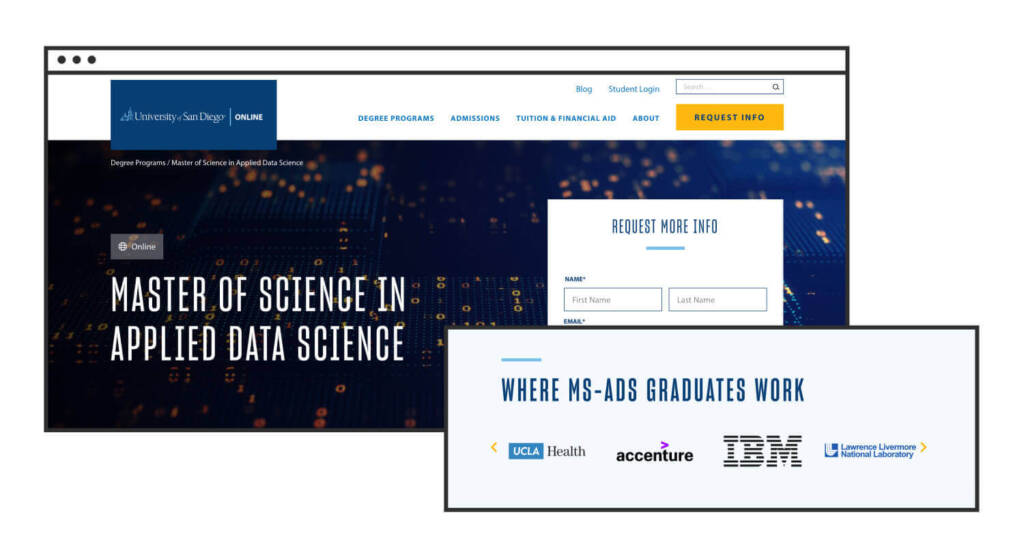
Example: University of San Diego Online Master of Science in Applied Data Science
This Vital client features a logo scroll of high-profile businesses and institutions where graduates have found work.
2. Highlight Career Advancement and Satisfaction Among Alumni
Testimonials and case studies featuring alumni who have advanced in their careers or are particularly satisfied with their educational experience can be powerful. These stories add a personal touch and make the outcomes more relatable.
Example: University of Cincinnati Online
Another Vital client, University of Cincinnati Online, makes alumni success stories a prominent part of their homepage experience.
